
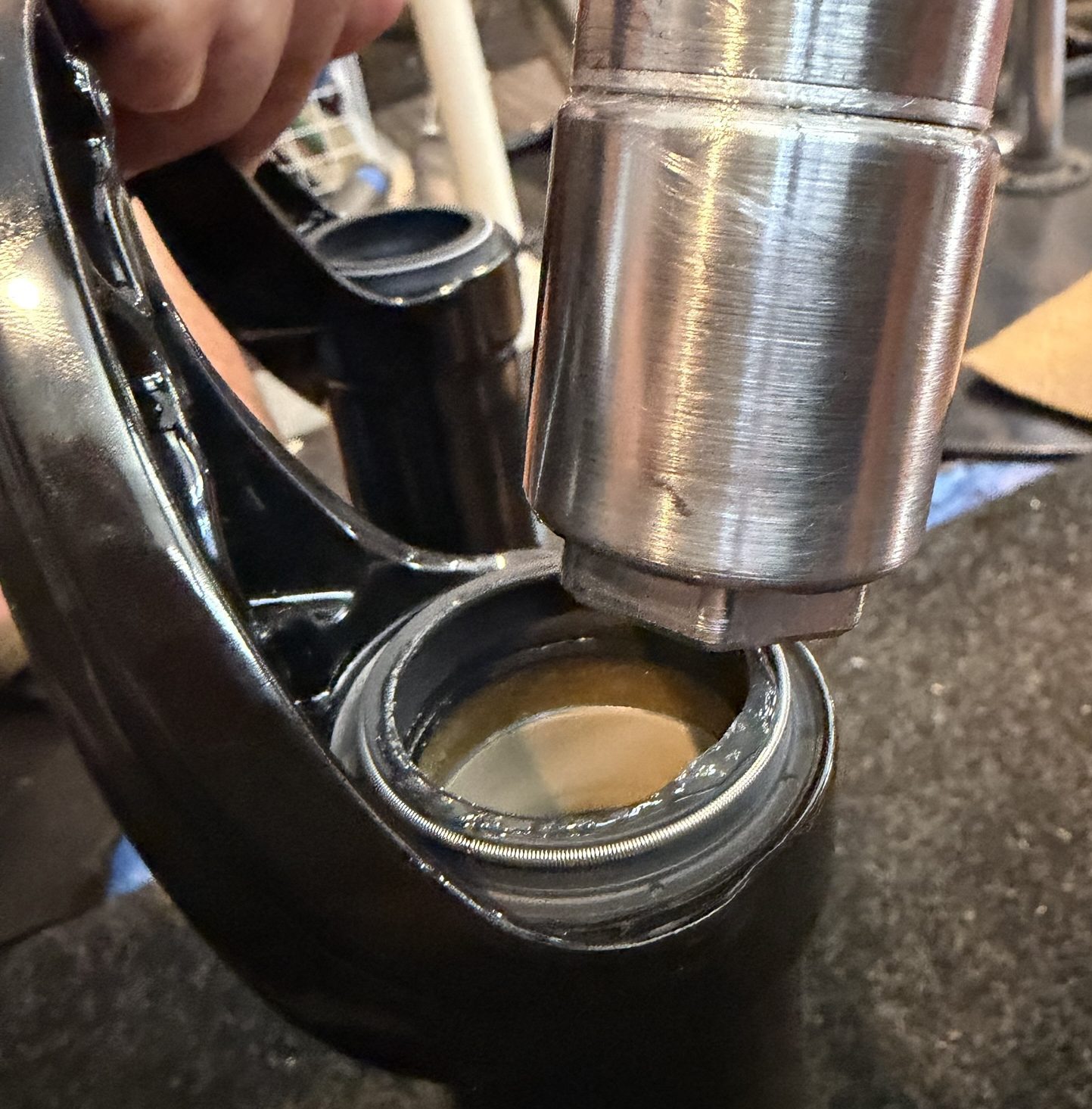
Bushing resizing on a mountain bike fork doesn’t get talked about nearly as much as rebuilds or valving, but it can make one of the most noticeable differences in how a fork actually feels — especially in that critical first inch of travel. At ST Tuned in Irvine, CA, we resize Fox, RockShox, Öhlins, Marzocchi, Cane Creek and DVO fork bushings as a $40 add-on to a full fork rebuild.
What bushings do
Bushings are the sleeves pressed into your fork’s lower legs that guide the stanchions through their travel. A small, precise gap between bushing and stanchion lets oil form a thin film — and that film is what makes a fork feel smooth. Too loose and there’s play; too tight and the oil can’t get in, so the bushings grab the stanchions. That friction (stiction) is something the fork has to overcome before it can even start moving through its travel.
Signs your fork bushings are too tight
- The fork feels sticky or notchy when you push down on the bars, and needs a real shove before it starts moving.
- Small, fast hits — braking bumps, roots, chatter — feel harsh, even with your sag and air pressure set correctly.
- You’ve dropped pressure and opened up the compression adjusters, and it still doesn’t feel supple.
- A new fork never “broke in” the way reviews said it would.
- The fork was just serviced with fresh oil and seals and still feels tight off the top.
If a couple of these sound familiar, tight bushings are a likely cause — especially on a newer fork.
Why new forks aren’t immune
It’s a common misconception that bushing issues only show up on old, worn suspension. In reality, factory tolerances vary, and pressing bushings into the lowers can leave them slightly undersized or out of round. Plenty of brand-new forks come through tighter than ideal.
What bushing resizing actually does
We resize bushings with a precision burnishing tool — it’s pressed through each bushing to expand it to the correct size and bring it back to round, without cutting material away. The result is a fit that’s tight enough to prevent play and keep steering precise, and loose enough for oil to do its job. Expect better small-bump sensitivity, less harshness off the top, and less strain on your seals, so they last longer. It doesn’t change your fork’s travel, spring or damping — it just lets the fork actually use them.
How we check for binding
Before and after resizing, Mike uses a slide test: with the stanchions lightly oiled, the uppers should slide into the lowers under their own weight. If they bind, it points to one of two things — tight bushings, or an issue with the stanchions in the CSU (the crown-steerer-stanchion assembly). Resizing fixes the first; the slide test tells us which one we’re dealing with.
Resizing vs. replacing bushings
Resizing fixes bushings that are too tight. It can’t fix bushings that have worn loose. If you rock the bike back and forth with the front brake on and feel a clunk or play at the fork, or hear knocking over rough ground, your bushings may be worn out rather than tight. Worn bushings can’t be resized, so we replace them — and we’ll tell you which one your fork needs before any work starts.
Why not do it yourself?
Burnishing tools are precision-machined for each stanchion diameter and cost several hundred dollars. Getting it wrong can leave a fork loose, with play you can’t undo. For most riders, having it done during a rebuild costs far less than buying the tool.
When to do it
Since the fork has to come apart anyway, bushing resizing is usually paired with a Factory Rebuild rather than done as a standalone service. If your fork is due for its annual service and has been feeling tight, that’s the time to ask for it. It’s also worth doing on a new fork that hasn’t felt right from the start.
What it costs and how long it takes
Bushing resizing is a $40 add-on to a full fork Factory Rebuild ($210), so $250 for both. If your bushings are worn and need replacing instead, we’ll quote that by fork model before any work starts. See our full price breakdown for everything else. Off-season turnaround (October–April) is typically 2–3 business days, and 5–10 days in high season. All work is backed by our 90-day warranty. Not local? Our mail-in suspension service works from anywhere in the U.S.
Bushing resizing FAQ
Which forks can you resize bushings on?
We work on Fox, RockShox, Öhlins, Marzocchi, Cane Creek and DVO forks across trail, enduro and downhill.
Do rear shocks need bushing resizing?
No. Bushing resizing applies to forks — rear shocks don’t have bushings that can be resized.
Will resizing make my fork feel loose?
No. The goal is the correct tolerance, not a loose fit. A properly sized bushing has no play; it just stops grabbing the stanchion.
Do I need bushing resizing if my fork feels fine?
If your fork is smooth and supple off the top, probably not. If you’re not sure, mention it when you book a rebuild and we’ll check the bushing fit while the fork is apart.
See you on the trail!
